
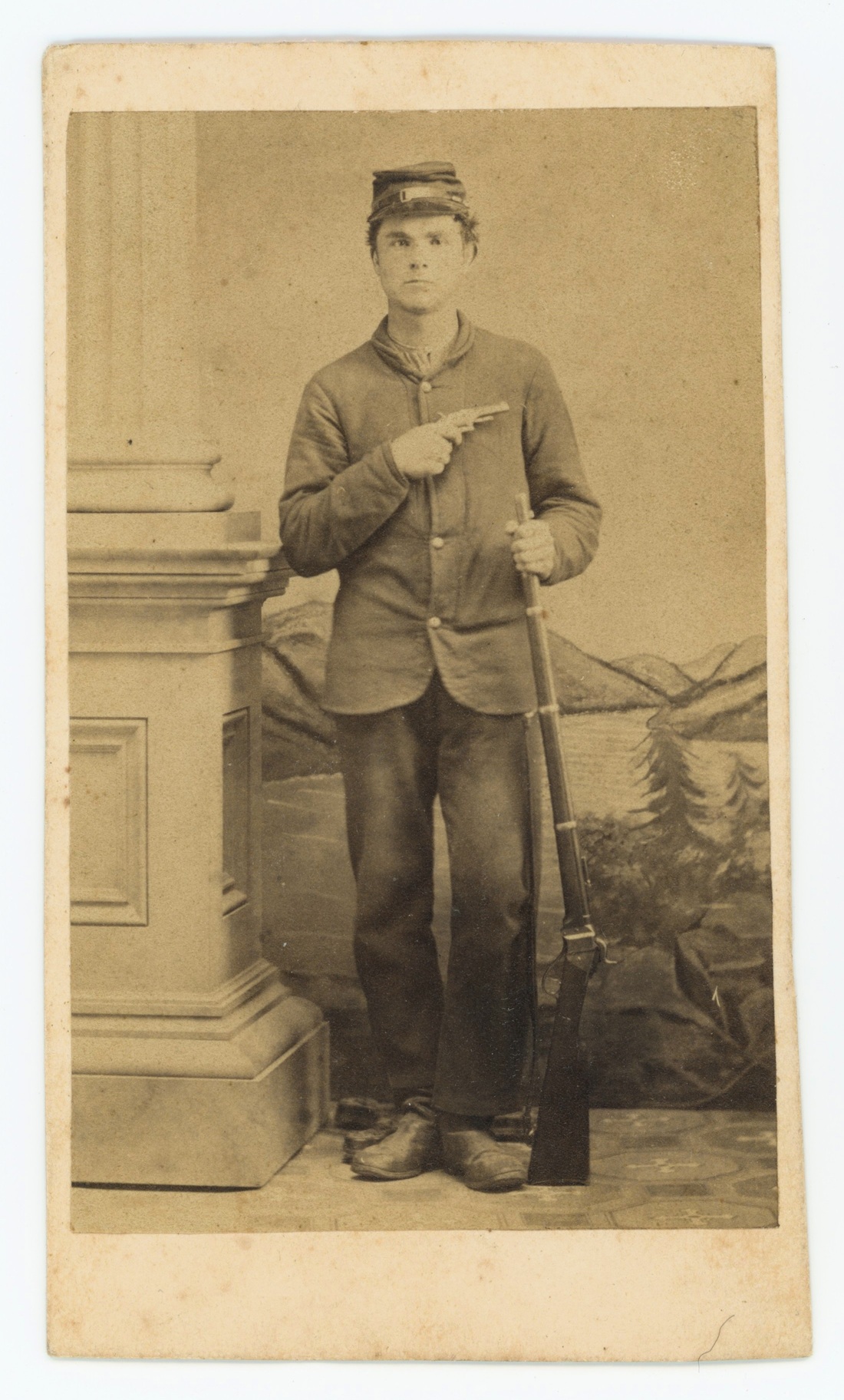
Eugene Burroughs, Company H (Vermont) Berdan’s 2nd U.S. Sharpshooters in a circa December 1863 to February 1864 portrait taken after his enlistment. While there is no signature, descendants of Burroughs himself previously owned the photograph but had erroneously attributed him as a member of the 6th Vermont Infantry. The only Eugene Burroughs on any Vermont roster was the sharpshooter. Further, the rifle he holds is a New Model 1859 Sharps in the “Berdan contract” configuration with double triggers, the very weapon used by the U.S. Sharpshooters beginning in May-June 1862. Identical examples of this backdrop can be seen in various other Vermont soldier photographs including those of some sharpshooters. His uniform would have consisted of dark green forage cap and trousers and a dark blue sack coat.
Burroughs was 18 years old when he enlisted with Company H 2nd USSS on December 10th, 1863. He mustered in one week later. Unlike many of his fellow recruits Burroughs managed to survive the brutality of the Wilderness, Spotsylvania, and subsequent battles of the Overland and Petersburg campaigns. There is not much written about his wartime service but one shining moment was recorded by his fellow Co. H sharpshooter Curtis Abbott. On June 21st, 1864, while attached to General Barlow’s division of the Second Corps, the 2nd USSS was sent forward as skirmishers before a maneuver that intended to cut the Weldon Rail Road from its connection to Petersburg, then under siege by the Federal army. The sharpshooters clashed with men of the dismounted 3rd North Carolina Cavalry, aggressively pushing them back under the cover of a scrubby woodlot from which they advanced. During the fracas the two lines became intertwined within the dense woods. Many sharpshooters had advanced to the rear of the confused confederate force and, in realizing their mistake, attempted to run the gauntlet back to the outer edge of the woods. Burroughs was among them and striking down a dirt cart path when confederate Colonel John A. Baker of the 3rd NC Cavalry, mounted on an immaculate white horse, came galloping down the path.
A surrender was immediately demanded and the officer ordered to dismount. Fearful that Burroughs would mistreat his horse, Baker offered gold in exchange for it’s care. Burroughs replied that he was no horse trader and stated he would turn the colonel and his horse over to “the commanding general.” After picking up several more sharpshooters in the woods, as well as another prisoner in the form of a confederate lieutenant, the group made it safely out of danger. True to his word, Burroughs delivered the two prisoners and the horse directly into the hands of General Francis Barlow. An account of the same ordeal was recorded by a Federal officer of Barlow’s staff. Upon his return from delivering orders to parts of the line the officer noted that Barlow was highly pleased with the “immaculately uniformed and poised colonel Baker, mounted on a handsome white horse, with a lieutenant bringing up the rear” (saddled behind the colonel). General Barlow was so impressed by the horse that he took it for his own and reportedly rode it throughout the rest of the war. The same horse is allegedly seen in the famous 1866 painting “Prisoners From The Front” by Winslow Homer.
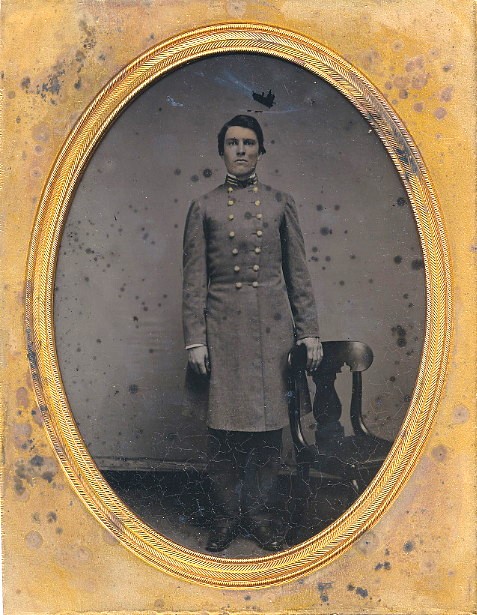
Colonel John A. Baker, 3rd NC Cavalry, the officer captured by Burroughs.
Burroughs would be a steadfast member of the 2nd USSS until their dissolution in February 1865. Post-1861 recruits and re-enlisted veteran sharpshooters still present where transferred into the 4th Vermont Infantry where they formed the nucleus of two skirmish and sharpshooter companies. Burroughs was promoted to Corporal in late June 1865 before mustering out on July 17th and returning home to Vermont.
Brian White Collection.
 They Expect Wonders of Us