
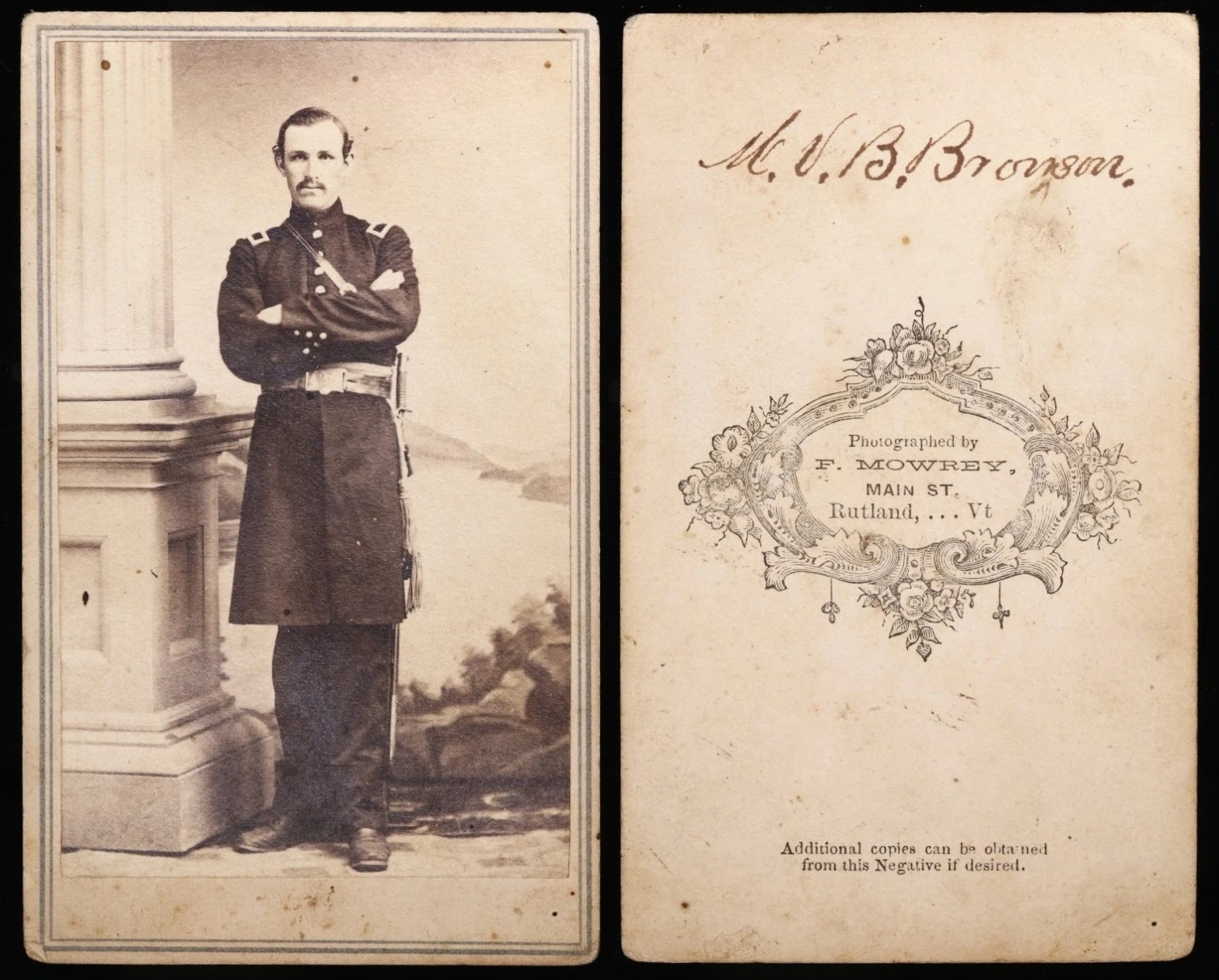
Martin Van Buren Bronson, Company F 1st U.S. Sharpshooters, in a portrait taken in the summer of 1862 while at home in Vermont on recruiting duty. A marble-cutter since the age of 11, Bronson eventually joined a company of Vermont state militia artillery before enlisting in the 3-month 1st Vermont Infantry in May 1861. The regiment took part in early actions on the Virginia peninsula near Fortress Monroe which culminated in the battle of Big Bethel. During the Federal retreat Bronson and a handful of other men with artillery experience were hastily detached to aide a battery of the 2nd U.S. Artillery covering the retreat. Bronson made it home and was discharged on August 15th; the same day he accepted a commission as 2nd Lieutenant in Berdan’s Sharpshooters.
Bronson would shine during the siege of Yorktown where on April 26th he and his men spotted a confederate observation balloon and quickly shot it down. Four days later Bronson directed fire against a confederate naval cannon posted in the enemy earthworks. According to some contemporary accounts the men shot sandbags around the piece, sending sand and gravel into the barrel, which eventually caused the gun to explode. Whether it was fouling that caused the failure or the fact that many pieces of CS artillery at Yorktown were poorly cast and tested, thus rupturing during use, is not known.
In late June 1862 in the midst of actions around Chickahominy Swamp, Bronson was detailed home to Vermont to recruit for Company F. He arrived in the Green Mountain state in early July and met with Corporal William Leach of Co. F who assisted in recruiting. The pair managed to raise over 50 men for their company and conducted them to the regiment the day following the battle of Antietam. The effort had gained Bronson a promotion to 1st Lieutenant in August and he was later charged with training the new men.
After surviving the battles of Blackford’s Ford, Fredericksburg, as well as the infamous Mud March, Bronson went up against a foe from his own regiment; Colonel Hiram Berdan. At the close of 1862 Berdan had been accused of cowardice in the face of the enemy, among other charges, and Bronson was but one of many junior officers who signed a petition to have their colonel removed from command. Unfortunately for the officers of the 1st USSS, the petition was improperly forwarded and later returned directly to the hands of Colonel Berdan. A wave of arrests and threats ensued. Bronson, just one of perhaps half a dozen officers, chose to resign his commission. He departed for Vermont in late February, 1863.
Interestingly, his story does not end there. Perhaps due to news of Berdan leaving command of the 1st USSS in the fall of 1863, Bronson decided to enlisted as a private in his former company that December. He served faithfully in the ranks among his old subordinates until the 1st USSS was disbanded in late 1864 before transferring into Co. E 2nd USSS (another Vermont company), and transferring for the second and final time into the 4th Vermont Infantry after the 2nd USSS was disbanded in February 1865. Bronson would take part in the Grand Review and mustered out in late June 1865. After the war he superintended his old marble quarry for several years before moving to Santa Rosa, California. He died in San Francisco in 1903 at the age of 67.
Brian T. White Collection.
 They Expect Wonders of Us