
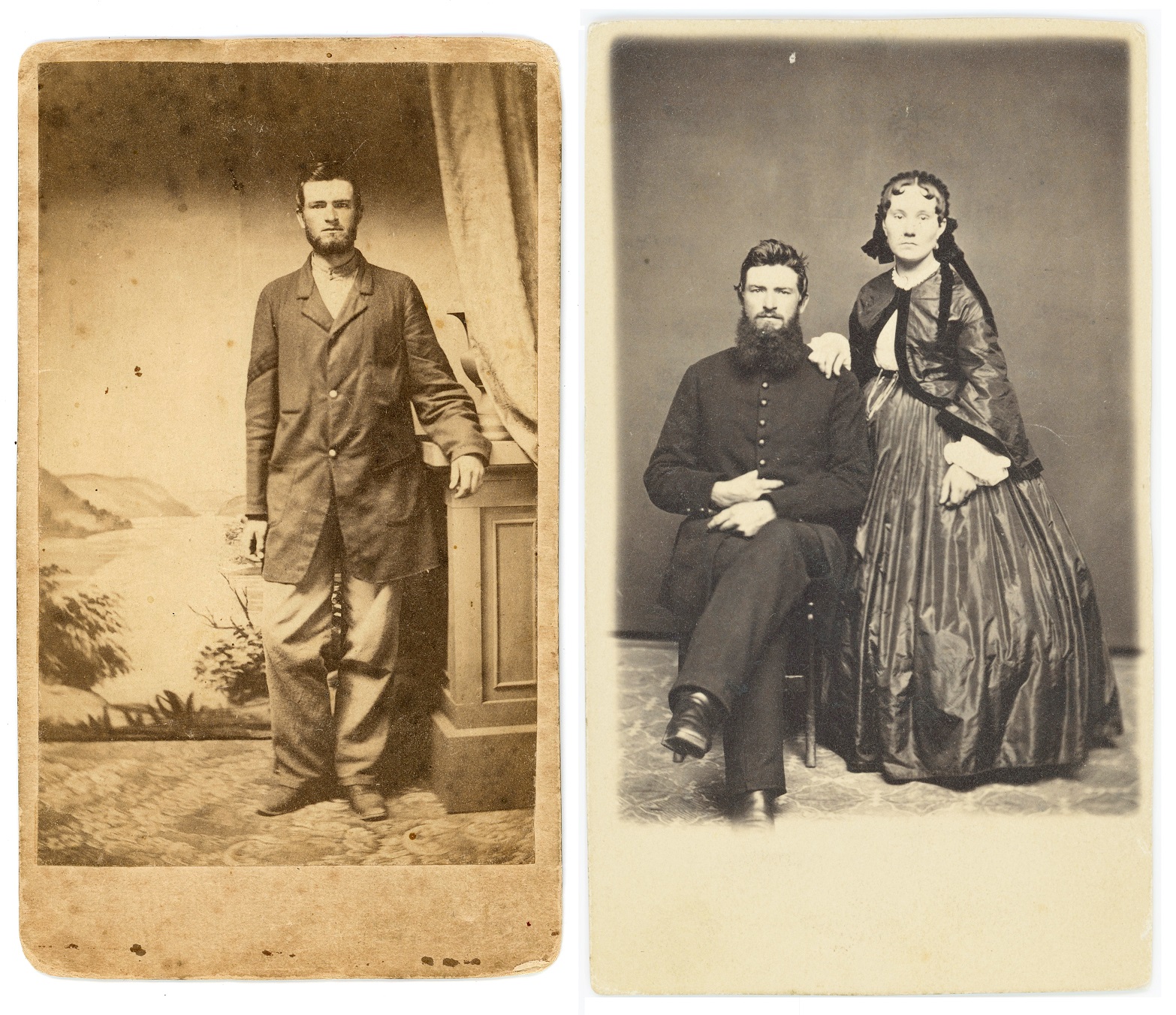
A pair of cartes de visite of Lewis J. Allen, the long-serving Sergeant and 1st Sergeant of Vermont’s Company F 1st U.S. Sharpshooters. The sharpshooters’ regimental historian Charles A. Stevens as well as General William Y. Ripley (Company F’s first captain) both noted with some pride that Lewis was a direct descendent of the famed Ethan Allen, a prominent American Revolutionary who was crucial in the capture of Fort Ticonderoga in New York and the founding of Vermont. He also formed the legendary Green Mountain Boys to police the British provinces of New York and New Hampshire and lobbied Congress to ratify Vermont’s statehood.
Born in Michigan in 1840, Lewis Allen was a lumberman and later a carpenter following his family’s move back east to their home state of Vermont. He was among the first group of Vermonters to enlist in Company F 1st U.S. Sharpshooters in early September 1861. By all surviving accounts Allen was a capable but ambitious sergeant during his wartime service, always doing his duty and taking care of his men. At the battle of Hanover Courthouse on May 27th, 1862, the sharpshooters found themselves part of a large detachment from the army which was sent to destroy the railroad bridges over the North and South Anna Rivers. Once the task was done Company F found themselves in advance of the detachment as they turned into a force of rebels soldiers attempting to cut them off from the main body of the army. Twenty sharpshooters were killed or wounded in the ensuing battle including three of Company F – Sergeant Allen and privates Benjamin Billings and William F. Dawson (who later died of his wounds). Allen’s wound was a very close call. According to regimental historian C. A. Stevens Allen had “got a whack side of the head, knocking him flat in the wheat field. Some of the boys rushed for him, but he got up and ran wildly ahead. He was caught by Peck and brought back, being a little off in his mind just then, but came around all right soon after. He proved a stayer and remained with his company throughout the enlistment, in all its trials and hardships. Sometime after, he was attacked with brain fever which he attributed to that blow, but recovered.”
One month later in July, following the army’s retreat to Harrison’s Landing, Virginia, Sergeant Allen was granted leave home to Vermont with Corporal William Leach to assist 2nd Lt. Martin V. Bronson in recruiting duty. While the cdv at left has no photographer’s imprint on the verso, the backdrop is incredibly similar to others used by Vermont photographers; it likely shows a view of Lake Champlain. Allen here wears a private purchase fatigue blouse with dark green chevrons and brass buttons, not unusual dress for sharpshooters away from field service. In October 1862 Lt. Bronson, Sgt. Allen, and Cpl. Leach returned to their company camped at Sharpsburg, Maryland with nearly 50 new recruits for their diminished ranks. Shortly thereafter Allen was promoted to 1st Sergeant, a rank he held until the end of his military service in October 1864. Despite having been promoted to 2nd Lieutenant in November 1863 Allen was never mustered by either U.S. or Vermont state officials. On January 2nd, 1864 Allen was one of only six men of Company F to re-enlist. The cdv at right shows Allen in a newly-issued dark green uniform with rubber buttons but minus rank chevrons, posed with a sweetheart or relative, while on his 30-day veteran re-enlistment furlough to Vermont.
While remaining unscathed for the war aside from his close call at Hanover Courthouse, Allen had another brush with death at the battle of Gettysburg. After their July 2nd skirmish in Pitzer’s Woods Companies D, E, F, and I of the 1st U.S. Sharpshooters retreated from combat in the face of the advancing brigade of Gen. Cadmus Wilcox’s Alabamians. While falling back Allen had the hammer of his Sharps rifles shot away and “swapped” rifles with a wounded sharpshooter using his weapon as a crutch. As the men scattered over open ground and back to the safety of the Federal lines along the Emmitsburg Road, Allen found himself at a local farm house. He burst through the gate and collapsed in the yard as the two women of the house came to his assistance. Thinking him wounded one of the two well-meaning civilians produced a butcher knife and cut off Allen’s equipment and accoutrements before he blurted out that he was not wounded. Once he caught his breath Allen spied some confederates approaching, gathered his ruined “traps” and beat a hasty retreat to safety. It was a story he reportedly enjoyed telling at reunions. A third brush with death came in late May 1864 when an artillery shell grazed Allen’s hip while laid in a rifle pit; the explosion wrecked his position but left Allen completely unharmed although the shock and concussion effected him for years.
Following his return to civilian life Allen divorced or lost several wives. He returned west to Michigan, settling in Battle Creek, and became an insurance broker and notary public. He also held a prominent position in the order known as the Comrades of Battle, being second in command, and was active in the Grand Army of the Republic. As the years passed Allen would suffer from “brain fever” caused by his minor head wound and physical pain from the concussion of the shell which almost ended his life. He was eventually admitted to the Soldier’s Home in Battle Creek and then Grand Rapids where he passed away in 1915 at the age of 75. The stalwart Michigan-born sharpshooter never returned to the Green Mountain State of his forbearers. Allen was laid to rest in Plot 7, Row 6, Grave 36 at the Michigan Veteran Home cemetery in Grand Rapids.
Brian T. White Collection.
 They Expect Wonders of Us