
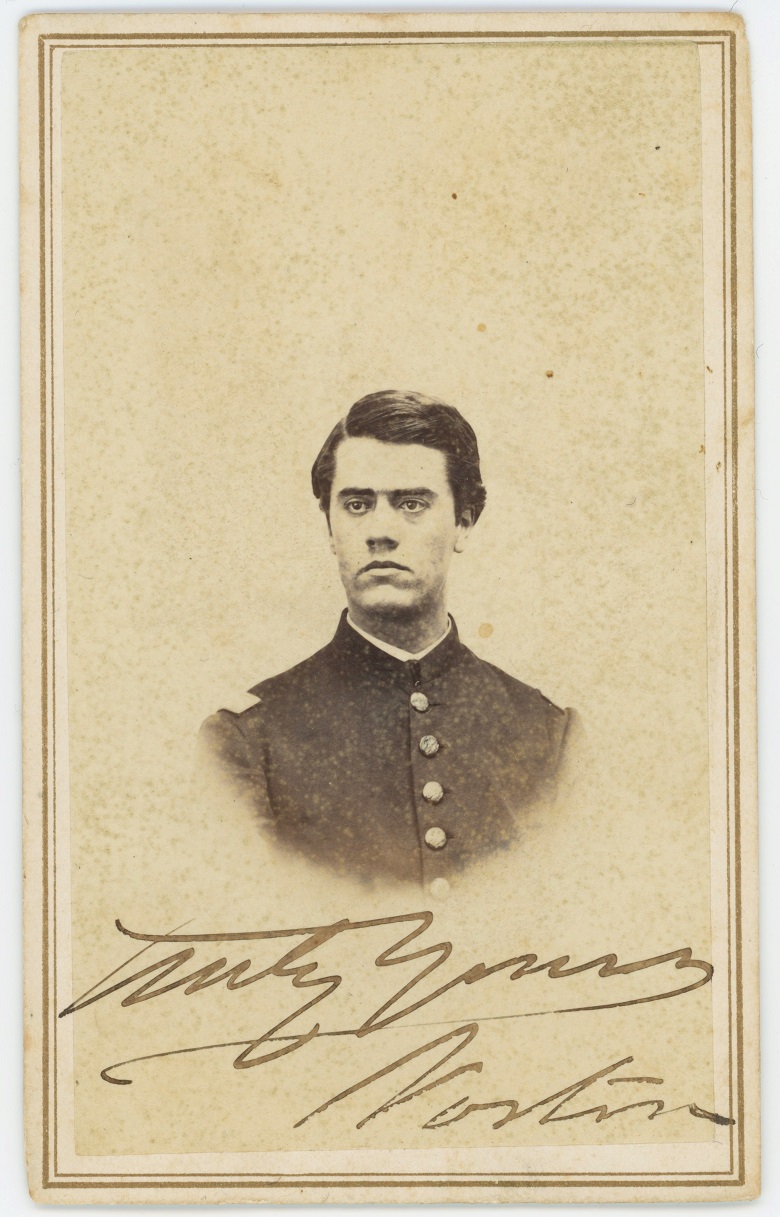
Captain Seymour F. Norton, Co. E (VT) 2nd U.S. Sharpshooters. Norton was a 20-year old teacher in Burlington, Vermont when he joined Berdan’s Sharpshooters in 1861. He was the first man to enlist in the “2nd Co. Vermont Sharpshooters” and was appointed to the rank of 1st Sergeant. In September 1862 Norton was promoted to 1st Lieutenant and received his commission two months later. Following the death of regimental adjutant Lewis Parmelee at Antietam, Norton was selected to fill the same role until promoted to Captain in Sept. 1863, after which he returned to command Co. E. After the dissolution of the 2nd USSS in late February 1865, Norton transferred into Co. G 4th Vermont Infantry and served as it’s commanding officer until mustering out that July. Following the war he moved to Michigan and received a law degree from Michigan State University. Norton then moved to Chicago where he practiced law for a short time before becoming a journalist and newspaper editor. In the election of 1896 he was supported as a presidential candidate by a faction of the Populist Party but failed to secure the nomination, losing 321 votes to 1,042 in favor of William Jennings Bryan.
Norton played a significant role at the battle of Gettysburg while serving as regimental adjutant. He first accompanied a 15-man party to Warfield Ridge to scout for the enemy but finding none in the area Norton returned to the regiment. Lt. Colonel Homer Stoughton then placed Norton in command of the left flank of the 2nd USSS, as well as the color guard, in the vicinity of the Slyder farm. Soon after Norton supervised companies B and F’s left flank positions several brigades of confederate general John Bell Hood’s 7,300-man division broke from the trees of Warfield Ridge, capturing five men of the earlier scouting party who had remained too long. The 2nd USSS opened fire at long range and almost immediately caused some panic among the confederate ranks but they were no match for brigades. As the sharpshooters’ right flank broke under the advance of Texas Brigade skirmishers, the rest of the line began falling back. While most of the regiment fell back through Devil’s Den or the Slaughter Pen area of the Plum Run valley, Norton, with Co. B, the color guard, and a handful of men from Co. F, fell back up the gently sloping foot of Round Top to the “D-shaped field” of the Slyder farm cattle pen. From there Norton and Captain Adolphus Guest of Co. B directed a fierce fire into the right flank of the 15th Alabama Infantry. Colonel William Oates of that regiment ordered it to wheel towards the firing to directly face Norton’s detachment; the 47th Alabama Infantry followed on the 15th’s left flank. The Alabamians were peppered with several more volleys before they advanced to the stone wall of the D-shaped field but when they arrived they found no Federal soldiers. Again, from further up the rocky slope of Round Top, the sharpshooters opened fire and further drew the two Alabama regiments up the hill and away from their prearranged course to attack the Federal left flank at Little Round Top.
The chase continued until Norton and his sharpshooters nearly reached the summit of Round Top. With the Alabama infantry still advancing Norton split up Co. B with the two platoons heading in opposite directions. Colonel Oates later stated that when his regiments reached the summit of Round Top all the firing ceased and the enemy had vanished “as though commanded by a magician.” After a short rest, made worse by the fact that the 15th Alabama had begun their attack without water, the two confederate regiments began their advance on the 20th Maine’s position on Little Round Top. At the same time back down the slope of Round Top, Norton’s party captured 22 men laden with full canteens who had been sent from the 15th Alabama for water. His prisoners in tow, Norton then advanced his party to the sound of heavy firing coming from Little Round Top, linking up with the other half of Co. B who themselves had sheltered behind a stone wall with a part of the 20th Maine. The hodgepodge detachment opened fire into the right rear flank of the 15th Alabama just before that regiment was charged on by the 20th Maine’s famous bayonet charge. Exhausted and parched, the Alabamians were swept from the field. While assisting wounding and taking prisoners, Norton found Lt. Colonel Bulger of the 47th Alabama sitting under a tree with a chest wound. According to the adjutant, the colonel was more than happy to surrender his sword and receive medical assistance. Norton kept Bulger’s sword for the rest of the war but lost it in the Great Chicago Fire of 1871.
Brian T. White Collection.
 They Expect Wonders of Us