
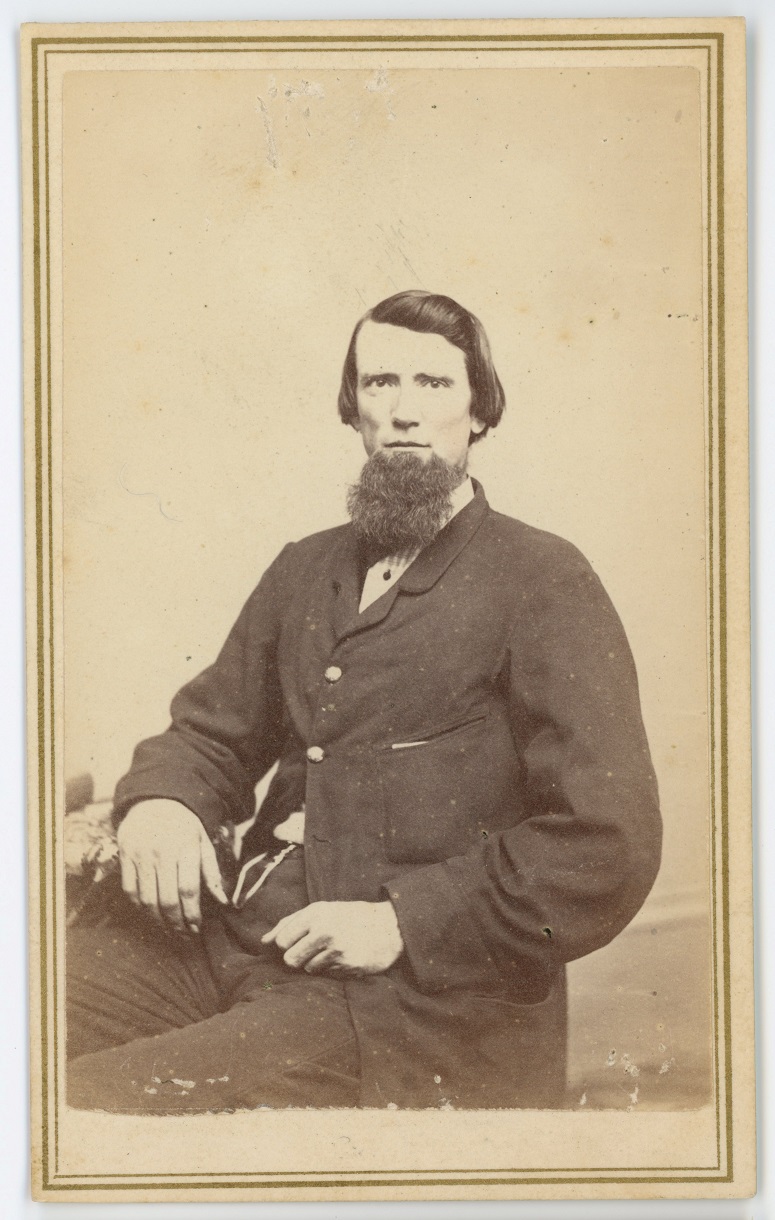
In 2014, at the Ohio Civil War Show in Mansfield, after several friends told me that a dealer had a “loaded” cdv album full of U.S. Sharpshooters cdv’s I was dubious to say the least. Full albums are rare enough as it is for any branch of service….civilians sure, but infantry, cavalry, artillery…those albums are usually long picked over. The dealer, Perry Frohne, had been told I was at the show and seemed to have been waiting for me to come by. In fact, on his table front and center was another sharpshooter I recognized although he was not part of the album. I asked if he had more and he pulled out stacks of rubber-banded sharpshooter cdvs from that album, each one secure in a rigid UV-protective plastic sleeve. It wasn’t just one stack but three and a half. As I went through them I began to immediately recognize the faces of sharpshooters I’ve seen published or in other collections. The unfamiliar faces were even more exciting to see and, coupled with a few hastily-scrawled signatures on the versos, the realization began to sink in that this album contained some (to me) legendary names. The first one of note was Sexton W. Williams. I knew the name and his life story but not his face. Here he was though; the lanky 6′ 7″ tall sharpshooter who had gone from Kentucky to California, back east, and into Virginia with a friend to join the famous Berdan’s Sharpshooters. After helping to ID several of the unsigned cdv’s I purchased this cdv of Williams with a few others and went on my way vowing to rebuild the contents of that photo album (story for another time).
Sexton W. Williams was born in 1829 on the Kentucky-Tennessee border to a family of slave-holders. Later seeking his fortune west he and a friend named Daniel Buckingham from Ohio struck out to the gold fields of California but were only able to scrape together meager wages. When the war broke out they joined the 2nd California Infantry in Oct. 1861 but found duty in the west boring; by February 1863 the friends made a pact to desert and head east to join the “real” war. After informing their Captain of their intentions Williams and Buckingham did what they vowed and departed from their company in the dead of night. A February 1864 account published in “The Summit County Beacon” of Akron, Ohio, claimed that the pair crossed the Sierra Nevada mountains and struck due east directly to Washington. An account written by fellow sharpshooter Wyman S. White claims that Williams and Buckingham went south to Panama, crossed that country on foot, and boarded a boat to New York and thence to Washington. Either way the two travelled they did indeed end up in Washington and reported themselves as deserters directly to Secretary of War Edwin Stanton. Williams explained that they were both seeking a legal transfer to Berdan’s Sharpshooters, a unit whose exploits they had read about in California newspapers.
The War Department placed the pair under arrest for a short time until their status as deserters could be confirmed. Having received the affidavit and high praise of their former Captain in California the two were granted civilian passes to visit the Army of the Potomac camped in Virginia. In April 1863 Williams and Buckingham literally walked into the camp of Company F (NH) 2nd U.S. Sharpshooters while they were enjoying morning coffee and drawing rations. Second Lieutenant Samuel F. Murry received the pair and took them directly to see Captain Edward Rowell. After sharing their tale and providing transfer papers both men were heartily accepted into their new company on April 27th. After being issued new uniforms, equipment, and Sharps rifles, Williams and Buckingham settled in for what would be a very short taste of winter camp; only days later they would take part in the battle of Chancellorsville.
Wyman White of Co. F noted that Williams especially was spoiling for a fight and had a bad habit of getting ahead of the skirmish line during his first battle. Williams eventually ran ahead so far and needlessly exposed himself. He was shot through the body by a Confederate soldier, the bullet passing through both hips and striking him in the wrist. White noted that in all of his years in and out of the army he had never heard a man howl and yell in pain and surprise as loudly as Williams did. He was left on the field and captured, soon falling into the hands of the very confederate soldiers who had shot him. Williams stated later that he was something of a marvel due to his great height but because of his wounds the rebels left him behind. He would survive the gunshot wound and later crawled into Federal lines where surgeons first treated him before sending him off to a northern hospital. Williams made a full recovery, as the bullet did not hit any vital organs, and returned to the company in November, 1863.
Since his original enlistment of 1861 in California was upheld Williams was eligible for a veteran furlough; he re-enlisted on Christmas Day, 1863, and traveled to New Hampshire with the men of his company for their furlough. White and others mentioned in letters and memoirs that Williams enjoyed himself in “high style” with his new friends and made many more acquaintances while in New Hampshire. Williams remained with his company throughout the winter and spring of 1864. Sadly, this brave man’s last battle would be on June 17th, 1864 at Petersburg, VA. While the opposing skirmishers and sharpshooters were relatively silent, Williams had created a small fire to boil coffee over before falling back to relieve himself. On his return Williams found that a comrade had removed his coffee and was preparing their own; as Williams’ annoyance grew he stood at full height to admonish his comrade. The 6′ 7″ tall Williams proved too tempting a target and a southern marksman took their shot. A bullet tore through Williams’ right elbow, shattering the bone. After being helped to a field hospital the arm was quickly amputated and Williams again was sent to a Washington hospital ward. He succumbed to infection two months later and is buried at Arlington Cemetery, plot 13-7897.
Brian White Collection.
 They Expect Wonders of Us