
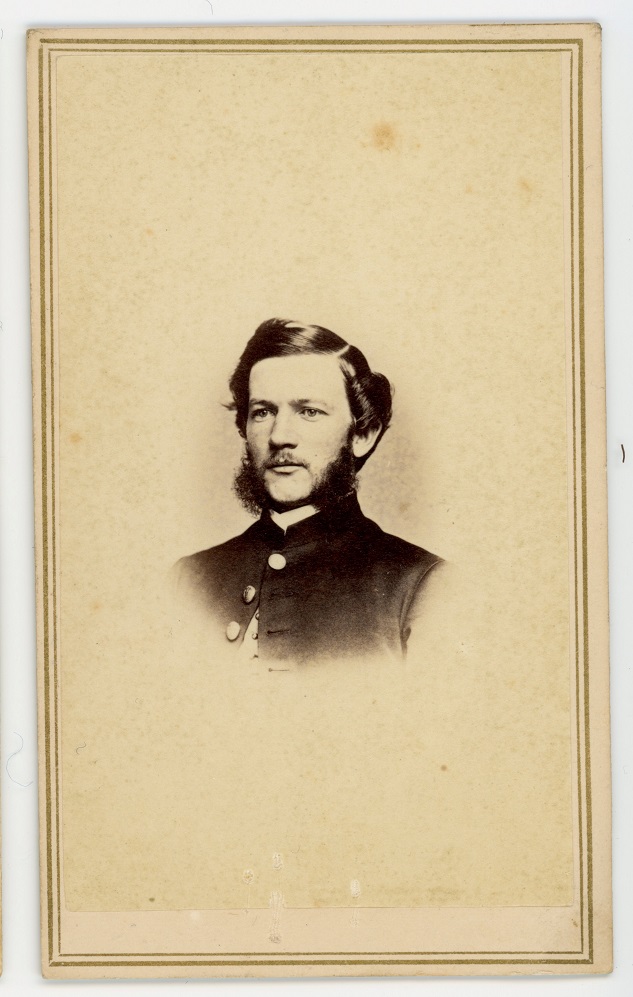
A duplicate of the very first sharpshooter image I found in the wild (eBay) back in the late 90’s right after I graduated high school. That first carte de visite was unsigned but I recognized Churchill from an identical image published in “The Civil War Diary of Wyman S. White,” which to this day is one of my favorite soldier memoirs. Thanks to the generosity of my inimitable friend and fellow collector Rick Carlile I was able to add Churchill back into my collection in early 2019.
William H. Churchill was a 27-year old resident of Londonderry, Vermont when he enlisted as a sergeant with Company H (VT) 2nd U.S.S.S. in October, 1861. On December 1st of the following year he was promoted to 1st Sergeant and served in that capacity until October 1864 when, having no remaining junior officers to command, the men elected him Captain. While the state of Vermont approved his commission Churchill was never officially mustered as captain and went into an October 27th expedition commanding his company but still holding the rank of 1st Sergeant.
During this expedition along Boydton Plank Road near Hatcher’s Run, Virginia, Company H’s skirmish line passed into a clearing and received a surprise volley and charge from a strong enemy line. Churchill and four other men were immediately struck and in the confusion he was left behind with Edgar Beach (recently elected 2nd Lieutenant). Fellow sharpshooter Curtis Abbott later wrote to his sister that both men had to be left behind as the enemy fire was too hot to enable a rescue, and the regiment left the field and marched north soon after the fight. While Abbott did not know Churchill’s fate but reported him dead, it was Beach who remained with him on the field for five days before both men were captured and given medical assistance. Beach noted that both men were robbed of their possessions and clothing by local partisans and believed that they would have been murdered if not for the arrival of regular Confederate infantry camping nearby. Churchill was removed to Richmond, Virginia and suffered an amputation of his wounded leg but succumbed to shock and fever on November 7th. He was purportedly buried in a small mass grave for Federal prisoners at Richmond’s Hollywood Cemetery. Edgar Beach would survive his wound and imprisonment; he was paroled in early February, 1865, finally being able to report Churchill’s ordeal to his comrades and family. A cenotaph detailing Churchill’s wounding and capture was erected in his family plot before war’s end.
This circa-1864 cdv was taken while Churchill enjoyed his veteran re-enlistment furlough home to Vermont. Like many of the re-enlisted 2nd U.S.S.S. men he was the recipient of a generous Federal and state cash bounty. Such funds likely purchased Churchill’s tailor-made non-regulation jacket or frock bearing Vermont state seal buttons seen in his portrait.
Brian T. White Collection.
 They Expect Wonders of Us